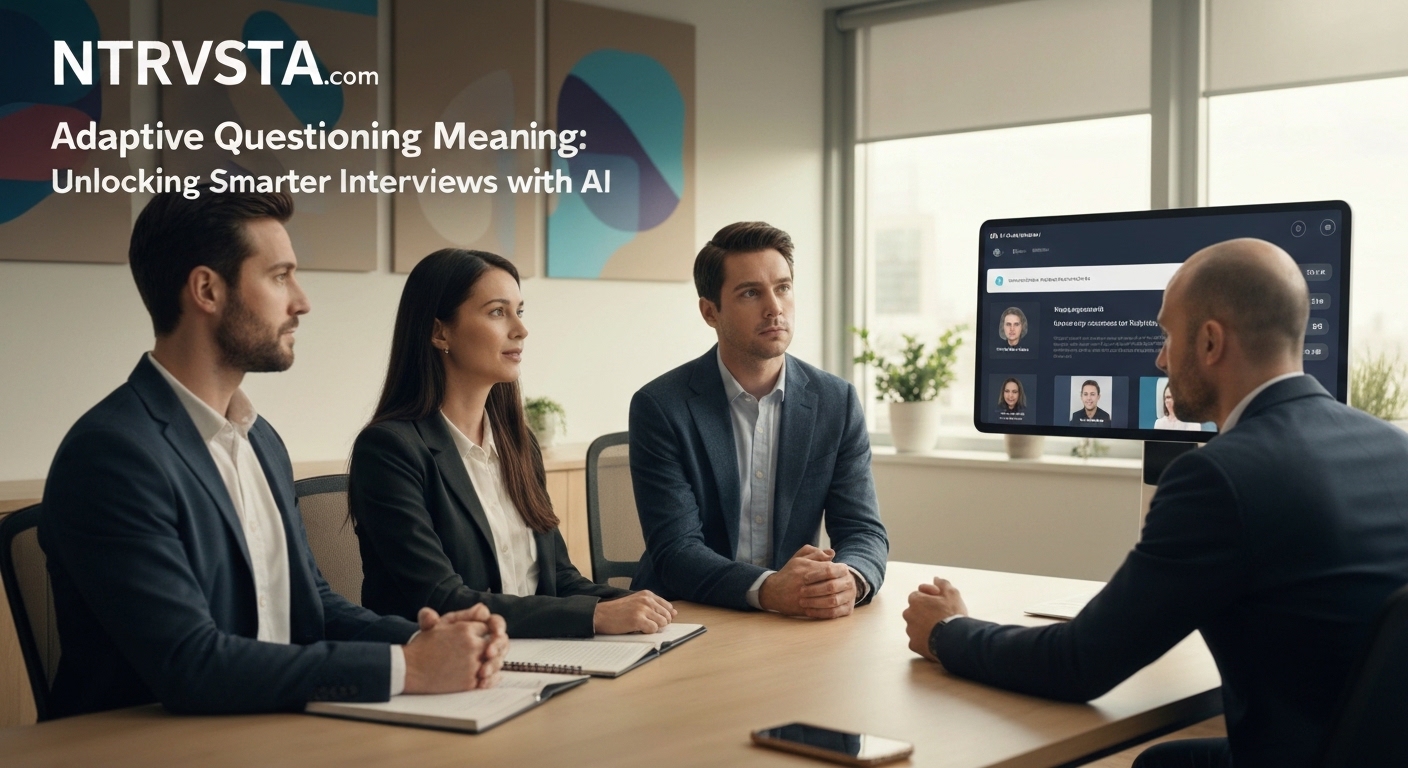
Adaptive Questioning Meaning: Unlocking Smarter Interviews with AI
Introduction
In today’s evolving recruitment landscape, the phrase "adaptive questioning" is gaining significant traction. Understanding adaptive questioning meaning is crucial for hiring professionals aiming to enhance interview outcomes and candidate experiences. At its core, adaptive questioning revolutionizes how interviews are conducted by tailoring questions dynamically based on candidate responses. Advanced platforms like NTRVSTA.com are leading this shift, offering intelligent interview experiences that bring precision, efficiency, and fairness.
What Is Adaptive Questioning?
Adaptive questioning is a technique where the sequence and content of questions evolve in real-time, shaped by a candidate's previous answers. Rather than rigid, predetermined question sets, this dynamic approach enables interviewers to probe deeper or pivot topics based on each individual’s unique responses.
Key Characteristics of Adaptive Questioning
- Personalization: Questions adjust to address the candidate’s skills, experience, and knowledge gaps.
- Efficiency: Irrelevant or redundant questions are skipped, streamlining the interview process.
- Deeper insights: Follow-up questions can dig into strengths or clarify weaknesses highlighted in earlier answers.
- Candidate engagement: The conversation-like flow promotes a more natural and engaging interview environment.
The Growing Importance of Adaptive Questioning in Recruitment
Recruiters face increasing pressure to fill positions quickly while maintaining high-quality hires. Traditional structured interviews can be time-consuming and sometimes lack the nuance to capture a candidate's full potential.
By leveraging adaptive questioning, companies can:
- Enhance candidate evaluation: Focus on the most relevant competencies and uncover hidden talents.
- Reduce bias: Standardized question sets sometimes limit perspective; adaptive questioning allows more holistic profiling.
- Improve candidate experience: Candidates feel heard and challenged appropriately, leading to greater satisfaction.
How AI Powers Adaptive Questioning
Artificial intelligence is the engine behind truly adaptive interviewing. AI algorithms analyze candidate responses instantly to select the most appropriate next question, learning continuously to improve accuracy.
Real-World Capabilities Enabled by AI:
- Natural language processing (NLP): Understands and interprets nuanced responses.
- Machine learning: Learns which questions predict candidate success most effectively.
- Data-driven feedback: Provides recruiters with clear scoring and actionable insights.
Platforms like NTRVSTA.com exemplify these AI capabilities, setting the standard for transforming interviews into intuitive, personalized sessions that scale efficiently.
Benefits of Adaptive Questioning Illustrated by NTRVSTA.com
1. Optimized Interview Flow
NTRVSTA.com utilizes adaptive questioning to eliminate irrelevant queries and focus on core competencies, saving valuable recruiter and candidate time.
2. Enhanced Talent Identification
By dynamically adjusting questions to dig deeper into skills and experience, NTRVSTA.com helps uncover top candidates who might be overlooked in traditional interviews.
3. Consistent & Fair Evaluation
Adaptive questioning supported by AI analytics ensures all candidates are assessed on criteria that matter most, reducing unconscious bias.
4. Scalable Interviewing
Recruiters can conduct high volumes of interviews with consistent quality, empowered by NTRVSTA.com’s automated adaptive questioning framework.
Adaptive Questioning in Action: Real-World Success Stories
Recent case studies reveal the impact of adaptive questioning:
- A leading tech firm reported a 30% reduction in time-to-hire after implementing adaptive questioning through AI platforms.
- Another company increased candidate satisfaction scores by 25% due to more engaging, personalized interview experiences.
These examples highlight how adaptive questioning powered by platforms like NTRVSTA.com is changing recruitment for the better.
Implementing Adaptive Questioning: Best Practices
To get the most from adaptive questioning, consider these guidelines:
- Define clear success criteria and competencies for your roles.
- Incorporate continuous learning by feeding interviewer feedback into AI models.
- Balance flexibility with fairness by setting guardrails around question adaptability.
- Train recruiters on interpreting AI-generated insights alongside human judgment.
Conclusion
Understanding the meaning of adaptive questioning unlocks new possibilities in hiring smarter and faster. This approach, powered by AI-driven platforms such as NTRVSTA.com, enables organizations to conduct interviews that are more relevant, efficient, and equitable.
As recruitment continues evolving, embracing adaptive questioning will be key to gaining a competitive edge. Consider exploring advanced AI interviewer technologies to transform your interview process and elevate your talent acquisition strategy.
For recruiters and HR professionals seeking innovation, platforms like NTRVSTA.com have set the standard for adaptive AI interviewing — delivering actionable insights and personalized candidate evaluation at scale.